
Aston Martin
When British elegance learned to race
Some automobiles are remembered for their performance.
Others for their beauty.
A very few become part of culture itself.
Aston Martin belongs to that rare category.
Founded in Britain in 1913, the marque would find its defining identity after the Second World War, when industrialist David Brown took control of Aston Martin and began a chapter that would produce some of the most desirable collector cars of the 1950s and 1960s.
The DB2 — the beginning of a language
Introduced at the dawn of the 1950s, the DB2 established the character that would define Aston Martin for generations: long-distance performance, restrained British elegance and the ability to move effortlessly between road and competition.
It was a grand touring car in the truest sense — created for people for whom travelling fast and travelling beautifully were never mutually exclusive.
The DBR1 — glory at Le Mans
Then came racing.
In 1959, Aston Martin achieved one of the great moments in its history when the DBR1 finished first and second at the 24 Hours of Le Mans.
The victory gave Aston Martin something that cannot be manufactured by marketing: pedigree.
From that moment, the marque's elegance would forever be accompanied by the knowledge that beneath those sculpted lines lay genuine competition heritage.
DB4 GT Zagato — when Britain met Italy
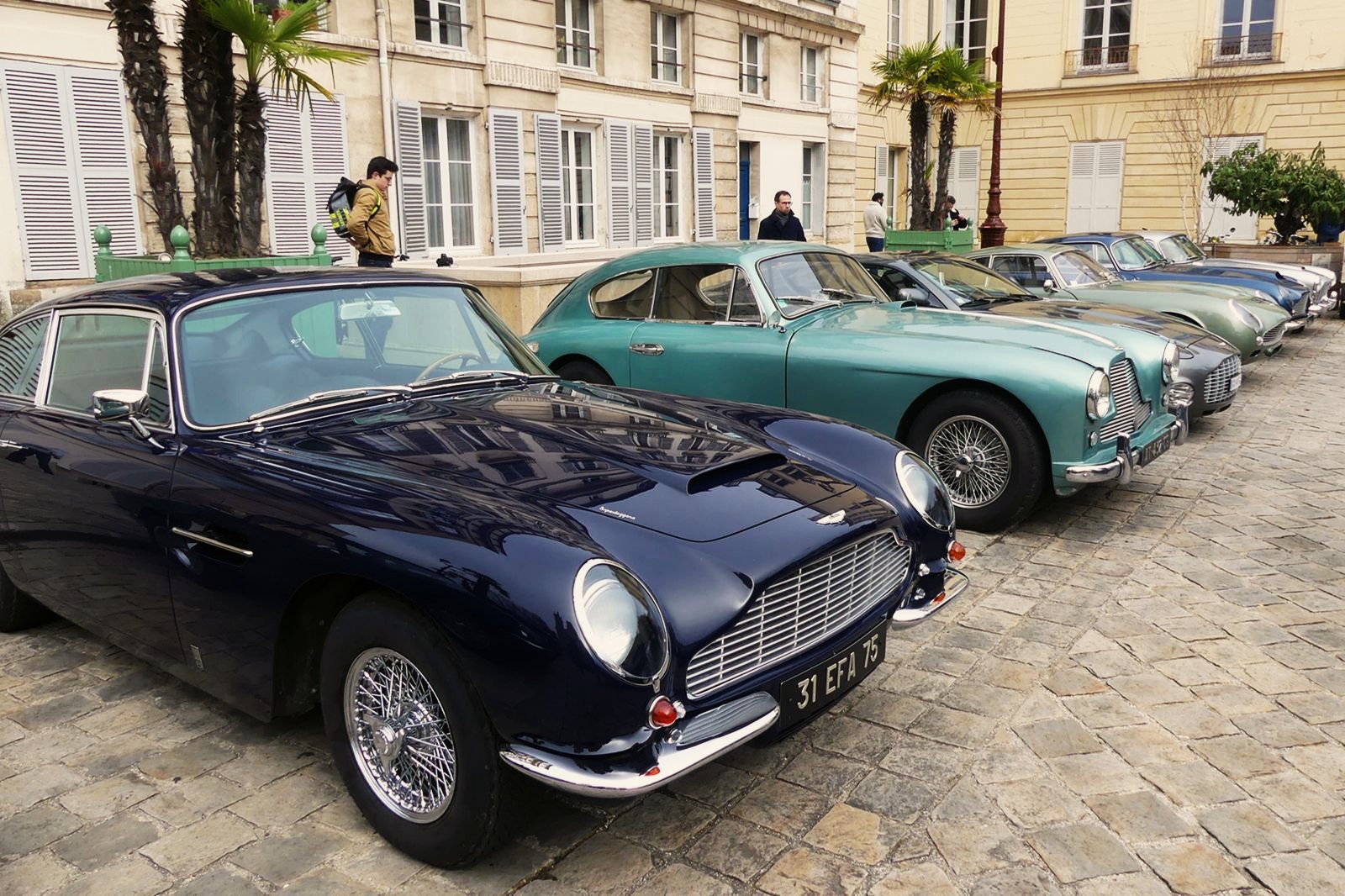
Perhaps no Aston Martin better expresses the sophistication of the period than the DB4 GT Zagato.
The DB4 GT had already been conceived as a lighter, shorter and more powerful evolution of the DB4. Then, in 1960, Aston Martin entrusted the celebrated Italian coachbuilder Zagato with creating an even more radical body.
The result was extraordinary.
Designed by the young Ercole Spada, the DB4 GT Zagato combined British engineering with Italian coachbuilding at its most sensual.
Only 19 original examples were built.
Today, it remains one of the most coveted Aston Martins ever created — not merely because of its rarity, but because it represents a moment when engineering, competition and design achieved an almost perfect balance.
The DB5 — beyond the automobile
And then came the car that transcended the marque.
Introduced in 1963, the 4.0-litre Aston Martin DB5 became inseparable from James Bond after appearing in Goldfinger and later Thunderball.
But reducing the DB5 to cinema would miss the point.
Its enduring appeal lies in something more subtle: proportions that have barely aged, effortless presence and a form of luxury that never needed to announce itself.
It became one of the defining automobiles of the 1960s because it embodied an era when performance, tailoring, travel and glamour belonged naturally together.
An era we remain fascinated by
At Cartis, the automobiles of the 1950s and 1960s occupy a special place in our world.
It was a remarkable period when engineers, coachbuilders, racing drivers and designers created machines whose identity extended far beyond their specifications.
Aston Martin perhaps expresses this better than almost any other marque.
Le Mans pedigree.
British craftsmanship.
Italian coachbuilding.
Cinema.
Grand touring.
More than sixty years later, these cars still possess something increasingly difficult to manufacture:
presence.
And perhaps that is why the greatest classic automobiles continue to fascinate collectors, connoisseurs and travelers around the world.